Tuesday, March 16, 2010

I don't know if i should be scared for these kids or of these kids


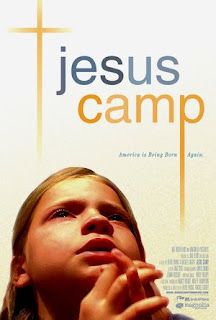
I went to Cinema Slapdown's viewing of JESUS CAMP a film by Heidi Ewing & Rachael Grady. It was held in our 1104 building, Thursday, March 11, 2010. it was such a breezy drizzly night. i got there early just in case it got packed. I was accompanied by my cousin, which i thought was a very bad idea of mine to bring her BUT in the end ended up being really good. we quickly ran for seats as soon as doors opened. while we watched other people come in, church music was playing in the background and i right away knew i might be uninterested. the film started a bit after 7:30pm and by that time the whole room was packed!!


this film was mainly to me about trying to bring back religion to the world. trying to make it all about GOD and the only way these people were doing it was through kids. Kids was the answer to them. they believed that children where gonna save the world from evil if they started "saving" them now. these kids are being home schooled by parents who tell them that science doesn't exist and that evolution doesn't exist. these kids are KIDS!! kids preaching at the age of nine. I'm not saying religion is bad, i just simply think that the Holy Spirit and abortion is too much for a six year old to handle.


I'm really happy i got to see this film. as soon as i seen the first scene where the kids had the Holy Spirit in them and how they spoke in tongues i right away knew this was going to be good. the first think that popped in my head were the flashbacks of my Grandmother's Pentecostal church. every time i went with her i knew i was in for a ride. i would sit and watch all the people and wonder if it was really the Holy Spirit of if they were faking it. i would watch people faint, people scream and cry and i all i did was watch. I'm really glad my cousin came with me in the end because as soon as we saw that scene we quickly turned to each other and said "grandma's chucrh!!." i was so even more speechless when i saw that there was a camp.


i think i related to the film more than i expected. i actually when to "church camp" for three summers, but i definitely know it wasn't as deep and scary as JESUS CAMP. yes it was a christian church camp but we had recreational activities and bible study every once in awhile. at night after dinner we had worship time and it wasn't as emotional as the kids in the movie were. i think we cried cuz we were homesick. (well at least i did) hahaha. i don't regret church camp. it was so much fun. i had a wonderful experience and I'm really glad my cousin went so that way when i tell my grandma my experience, she won't think I'm lying :)


ENJOY

Wednesday, March 3, 2010


The Critical Encounters event I went to was ‘Information Piracy and Creative Commons in Contempoary Art and Design’. This even was located in the Glass Curtain Gallery located in the 1104 S. Wabash building. This exibation featured many different artists pieces and such artists were: Sze Lin Pang, Line Langballe and Christina Okai Mejborn of Totem Collective, to name a few. The gallery itself was simple in its design layout and such but the art itself was very complex.

I selected this event for 2 reasons, one was because the description of the event sounded interesting and made me curious of what it was exactly about and then the second reason was because I had to go to the building anyways to pick up some art work so it was convenient. When I first walked in I was surprised at how simple everything was, as I stated before the setup was simple but when you dove into it and looked at some of the pieces of artwork they were filled with color and mixed medias. What surprised me the most was the artwork itself, the description talked about the use of existing materials and turning them into something new but most of the art were things that were deconstructed, such as the unassembled lamps located in the middle of the gallery, when I saw these I thought they were still setting things up to be honest.


The most memorable thing about this event was probably the plasma screen they had in it that had the moving pictures you could control. I thought this was a great piece because it was interactive art at its finest, though you yourself did not pick the images you got to arrange them and decide were they ended up and that is creativity not only for the artist but the people viewing the piece, it just made it more personal.


That piece of art was one way to relate to the gallery but really that was the only way for me personally. There were two interactive stations with computers, also some headphones you could listen to, these were things that took you into the art but some of the stationary art was just kind of no-relatable for me.

I think the question that the creators of the gallery focused on might probably would have been ‘What is the process of creation? What is the process of discovery? How are they different?’ I think this because the whole exhibit itself had to do with the creation of new art out of old things, i.e. the process of creation, old to new and in the process you discover new things about either the material or your artistic abilities.

This event interacted with things we have talked about in class by relating back to the matter of fact. This whole exhibit was based off of fact, the thing themselves were fact, meaning which they were definite things, as soon as you looked at them you knew what they were or what they had been. Though that is a vauge way to relate this whole exhibit about to out class it is the only way I know how, in class we have focused more on the ‘faith’ part of these two I think and this was more on the ‘fact’ side.


All in all I think it was a well put together exhibit and had some good pieces in it, though with more time I wish I could have investigated what the video in the back was about. I watched it more a few minutes but I was not sure how far into it I was and what was going on really. Also I could not hear the sound very well so I was kinda lost. I know it was about a family and the father was talking to his children about growing up and things at the part I saw but I just wish I could have seen and understood more.

Monday, February 22, 2010

walking in waters


I went to the Incornate (the body idenity and Interactive Media)
IT was located on 618 South Michigan AVE on the 2nd floor. Majority of these art work was really good and I like it because It involves of Interactive Arts and Media (in a way) and that is my Major that I am taking up/ studying. It was really awsome of how these different creators thought right outside the box with something this interesting.

Sunday, February 21, 2010

Suburban Promise Land


The event was about the emerging Oak Park African-American community between 1880-1980. Stan West, who is the author of "Suburban Promise Land: The Emerging Black Community in Oak Park, Illinois, 1880-1980", talked about the rich history of Blacks and biracials in suburbia, many of whom migrated from the South and immigrated from Canada in an act of "faith."

I picked this event because, all of the events I was attending in the month of February focused on African-American history. So I continued to follow events along that curriculum that focused on the history of the African-American culture. I was surprised how the author really dug deep to find out information that any other person couldn't possibly get their hands on. He was very informative and spoke with conviction. Other things that stood out was the audience and time it took to finish the book. It was a very personal one-on-one book discussion. So there was a lot of involvement from the audience. The time it took was about a decade. What stood out to me as memorable was the amount of information he knew and his sense of humor. One of the things that really stood out was a newspaper clipping that he showed which he placed in his book, had a article about the KKK, recruiting any prospect in a daily and widely known and published publication. The thing that stood out to the particular bunch of KKK members in Oak Park was they were not targeting so much African-Americans but were focusing on Jewish people and people of the Catholic faith and religion. I could relate from the standpoint of moving to another area for a better opportunity. I could also relate to their stuggle to want to achieve and make something better out of life. I couldn't relate to the amount of discrimination going on in that time period.
I think the creators or curators had these questions in mind: What role do the media play in the way we make decisions about belief? Do they relay what is fact?
  • Why do we believe as we do? What experiences have shaped our beliefs? How do we respond when our beliefs are challenged?
  • What shapes ethics and morality?
    How do our beliefs and discoveries transform our relationship to people, places, society, the planet?
I believe what help me curve my conclusion was the information that was given in the book and what the book was about. This topic relates to the topic of "Why do we believe in race"?. This book and event unarguably relates to what we've discuss in the class. With brief excerpts from books such as "No mans land", "I'm Down", and the scientific article about race.

Would more time I would consider exploring and diving deeper to find out more about this topic and sub-topics that relate to this event and book.

The author actually gaves us links from youtube, on a documentary that he worked on called the "Achievement Gap". This is some of his other work.


Friday, February 12, 2010

Why Evolution is True

*Please forgive this layperson's retelling of a lecture presented by a scholar. If you find any inaccuracies in this posting, please inform me and I'll make corrections.


Monday, February 8, 6:30 pm
Ferguson Auditorium in 600 S. Michigan Ave, room 101

Jerry A. Coyne, Ph.D. presented the findings collected in his book Why Evolution is True. He discussed where evolution falls in the conversation of Fact & Faith.


When Professor Eric Scholl visited our class in the second week of the semester, he passed out flyers about this event and made an aside about how the title for Dr. Coyne's book leaves little wiggle room. I thought it would be interesting to hear someone speak so unwaveringly about Fact & Faith, or at least about science and religion. Dr. Coyne did not let me down!

He began by discussing the definitions of words as they're used scientifically. Coyne says that laypersons assume theory implies that an idea is still under consideration, still requires more proof before it becomes fact. Coyne informs us, however, that the word theory is interchangeable with scientific fact. Evolution is a theory; it is also a scientific fact.


Coyne showed this chart. The list at left are the 35 most "developed" countries. The blue bar shows what percentage of each country's citizens/residents believe evolution is true. The yellow bar shows what percentage is unsure whether or not evolution is true. The red bar shows what percentage believes evolution is false. Of these 35 countries, United States is ranked 34. Only about 40% of our population believes evolution is true. Of this list, only one other country has fewer citizens who believe in evolution.

So Coyne began showing us why we should believe in evolution. I don't intend to retell his lecture. (I'm already worried about how accurately I'm retelling the facts/ideas I include in this blog.) Here are some highlights:

Our design flaws serve as proof for evolution.

Scientists believe/know that the first life developed as microorganisms in water. They became plants and animals in water, and these plans and animals evolved into other plants and animals that could live on land. They also believe/know that land mammals eventually returned to the water. In the last 20-30 years, scientists have found information that connect the animals that first moved from land to water to our contemporary whales and dolphins.


Above is the skeleton of a humpback whale. You can see a small white dot at its pelvis. This white dot is a bone that land mammals also have, and from this bone develops hind legs. Of course, whales and dolphins don't have hind legs, but they do have remnants of their ancestors' hind legs in their skeletons. Occasionally whales and dolphins will develop hind flippers from this bone. This bone and these occasional hind flippers serve no purpose to these whales and dolphins.

The design flaws he mentioned in humans included our tendency to develop pain in our backs, women's painful and dangerous childbearing, and men's problems with their prostates. (Coyne asked, why would a benevolent power/being, or even an indifferent power/being decide to place a gland that tends to swell (prostate) around a collapsable tube (urethra)?)


There are no endemic mammals, reptiles, or freshwater fish on islands that developed from volcanic eruptions, places like Hawaii. (They do occur naturally on islands like the United Kingdom or Madagascar, land masses that broke off a larger continent.) Yet, when mammals, reptiles, and freshwater fish are introduced to these islands, they can survive and thrive.


Coyne argues that if mammals, reptiles, and freshwater fish weren't intended to live on Hawaii, if some being had decided they shouldn't live on these islands, then they shouldn't be able to survive and thrive there. He says that birds and plants typically inhabit these sorts of islands because they could drift/fly there. Mammals, reptiles, and freshwater fish, of course, need to travel there via other constructs/beings.


I could go on and on. When I got home that evening, I quickly relayed as much as I could remember to my husband. I was enthralled by the evidence and fascinating facts I didn't know about evolution. Dr. Coyne said that his students from 20 years past have told him what they remember from these lectures and he ensured us we'd remember some of this information for at least 20 years.


But with our Writing & Rhetoric II class in mind, and with Critical Encounters: Fact & Faith in mind, I shall continue...

I think the creators of this event certainly had this question in mind: "What is objective truth? Does it exist? Can it be captured?" Coyne says in countries where many people believe in God, fewer people believe in evolution. In countries where few people believe in God, many people believe in evolution. He says that countries where many people feel secure (job satisfaction/security, health care, stability), few people believe in God. In countries where many people feel insecure, many people believe in God. (I realize the trouble with my using words like few and many to stand in for real statistics.)

"Where do fact and faith intersect? Is proof necessary for belief? What is the relationship between personal faith and the development of fact? How does one's faith shape his/her perspective of fact?" Coyne says that writing his book may be purposeless if we continue to live in a country with such a strong belief in God. He says we need to change our society, live in a country where we can feel more secure (not move, but change our country to increase its stability), eliminate our belief in and reliance upon God, and believe what he considers such straightforward facts that support the theory of evolution.

"How do fact and faith influence what it means to be human?" Coyne believes unequivocally in scientific fact.

"How do our beliefs and discoveries transform our relationship to people, places, society, the planet?" Coyne studies life. He wants to understand our world and how it became this way through evolution. He wants to share that knowledge and understanding with others.

"What is the process of creation? What is the process of discovery? How are they different?" It seems that we are constantly creating in our constant evolution. It seems that scientists discover when they understand how this creation happens.


I thought of our class often during the lecture and discussion. Many of you are writing about that place between pure fact and pure faith. Some members of the audience wanted to make clear that it's possible to believe in God and evolution. Coyne doesn't believe there's room for both -- either you mistakenly believe in God or you correctly believe in evolution.

With more time, I'd like to explore with you the boundaries of these words, fact and faith. When are they interchangeable? When are they completely separate? Do you think evolution is purely fact and therefore true? Do you think religion is purely faith and therefore false?

The New York Times Magazine published on 2/14/10 an article called "Founding Father?: Conservative Activists on the Texas Board of Education Say that the Authors of the Constitution Intended the United States to be a Christian Nation. And They Want America's History Textbooks to Say So, Too." Russell Shorto wrote the article.

I will read the article and probably edit my post or simply discuss during class. I wonder how this connects with science books that acknowledge both evolution and creationism, or only creationism.

Wednesday, January 27, 2010

Class Presentations

Monday, February 22
  • Jazz
  • Victor
  • Coop
  • Serenity
  • Devin
  • La'Quan
Wednesday, March 17
  • Bobby
  • Anna
  • Vanessa
  • Alyssa
  • Xochitl
  • Shalynn